
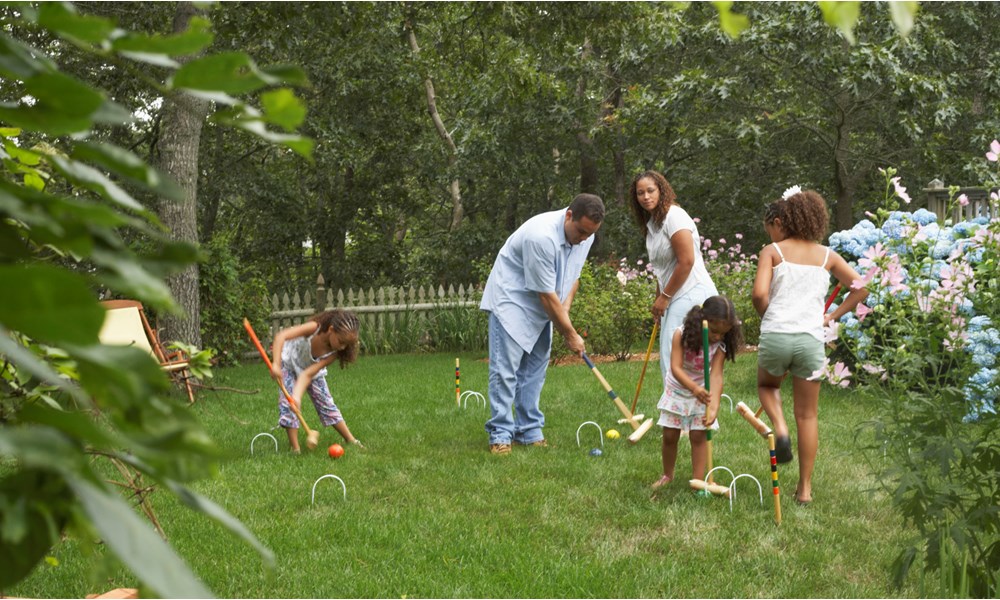
For more than 100 years, croquet has been played in backyards and on community courts across the world. There are many variations of the game and different rules for individuals, teams, and tournaments. The following instructions from 3 Birds Auto will help you play a simple game of backyard croquet.
Croquet Equipment
A basic croquet set comes with six mallets, six balls, nine wickets, and two stakes. The balls are each a different color, and the mallets typically have stripes which match the balls. The stakes are usually striped with the colors of all of the balls in the order of play. The order is always: blue, red, black, yellow, green, and orange.
Setting Up the Court
A backyard croquet court should be a flat, grassy area that is 100 feet long by 50 feet wide. In casual games, the court size can be modified to fit nearly any available area. The stakes are placed at the center of either end of the court (about 100 feet apart). Croquet wickets are positioned in a double-diamond pattern between the two stakes. Two wickets, each six inches apart, are placed in front of either stake. A center wicket is placed halfway between the stakes. Halfway between the center wicket and each stake, two wickets are centered about 50 feet apart.
Object of the Game
Players earn one point for passing through each wicket and two points for hitting each stake. Each turn consists of hitting the ball one time (unless the rules allow for bonus strokes). The winner is the first player to earn 14 points by making it through the entire course.
Play follows a specific pattern. Starting at a position between one stake and its closest wicket, the croquet ball must first pass through the two wickets close to the stake. It then passes through the closer right-side wicket, the center wicket, the far right-side wicket and the two wickets by the far stake. The ball must also hit the far stake. It then follows the same path back, using the left-side wickets and striking the beginning stake.
Points and Bonus Shots
Points are scored as the croquet ball passes through each wicket and hits each stake.
One bonus shot is earned each time a ball passes through a wicket or hits the turning stake. Bonus shots are taken immediately after they are earned. If the ball passes through two wickets, two bonus shots are earned. If the ball passes through the two far wickets and hits the turning stake in one shot, two bonus shots are earned (not three).
Two bonus shots are also earned when a player strikes another player’s ball. This is called a “roquet.” The first bonus shot can be used to continue play or to knock the other player’s ball farther away. The second bonus shot must be used to continue play.
Though it might take a little time to learn all of the rules’ finer points, players can generally learn croquet rather quickly. Beginning players should keep a set of croquet instructions on hand to avoid disputes. Whether playing in a spacious backyard or at a community court, it’s easy to see why croquet has endured as a favorite recreational pastime.